

In Norway Park, just off Highway 61 outside Thunder Bay, a grey stone stands behind a row of flags. It is made from larvikite, and it was a gift from Norway, in honor of the two Norwegian-Canadians who brought ski jumping to Thunder Bay: Knute and Thor Hansen, who “began the dream now known as ‘Big Thunder’, in their inimitable Norsk way.”
Harald and Sigrid Hansen brought their family from Oslo to Fort William circa 1928. Their children were Knute, Arne, Erling, Tor and Esther, who later married Albert Mackereth. The boys brought their passion for ski jumping with them.
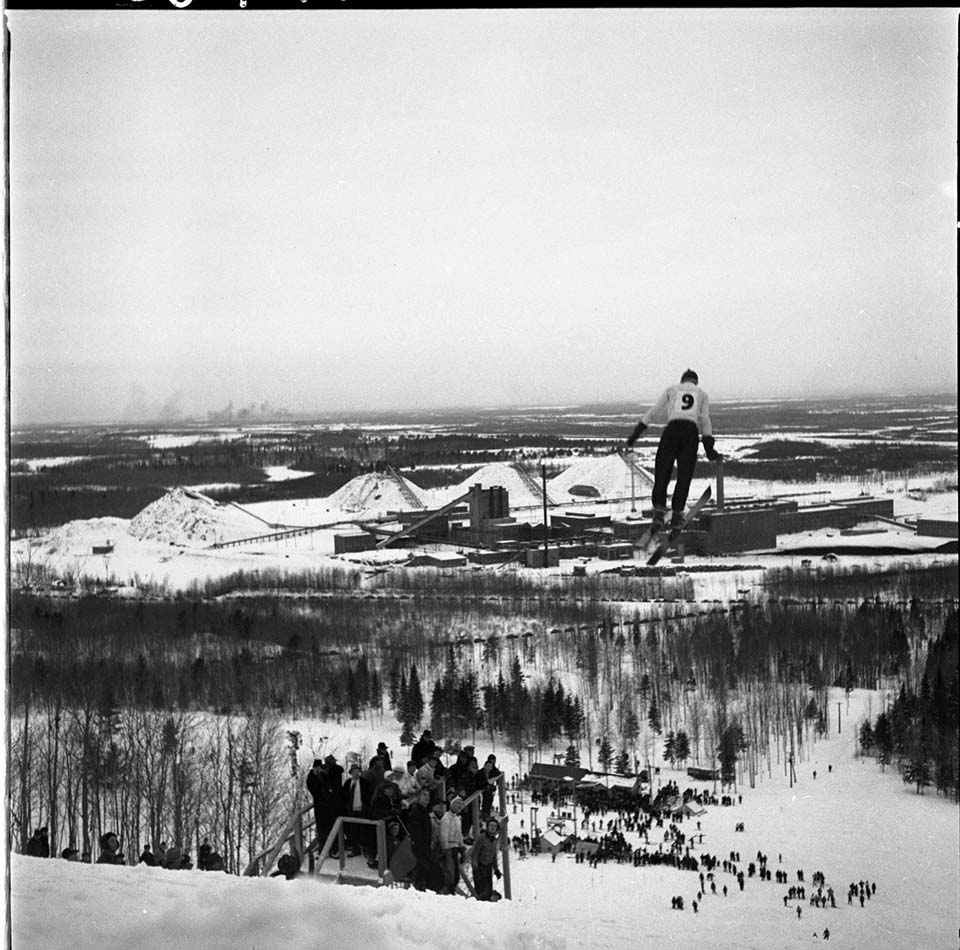
A 1933 photograph shows Knute Hansen (1915–1988) and Erling flying off the Fort William Ski Club’s big jump side by side. Thirty years later, local sports writers remembered the brothers as “once Canada’s best in this field,” and Knute as “once the best jumper in Canada.”
Tor Hansen (1921–2016) went to Francis Street school and Selkirk Vocational. He jumped with his brothers “with an eye toward competitive ski jumping,” his obituary says, until the Second World War made him a gun layer instead. After the war he became a display artist at Chapples department store. Every Christmas he designed the store’s Santa Claus show and performed in it as “Mister Chris”. He also built sets for the Fort William Little Theatre and the Cambrian Players, and in 1981 supervised “Awakening the Giant,” the 20-foot figure for the Canada Games. His son from his first marriage, the famous local actor and director Kim Hansen (1953–2019), founded Masterfeast Dinner Theatre at the Prince Arthur hotel.
Mount McRae
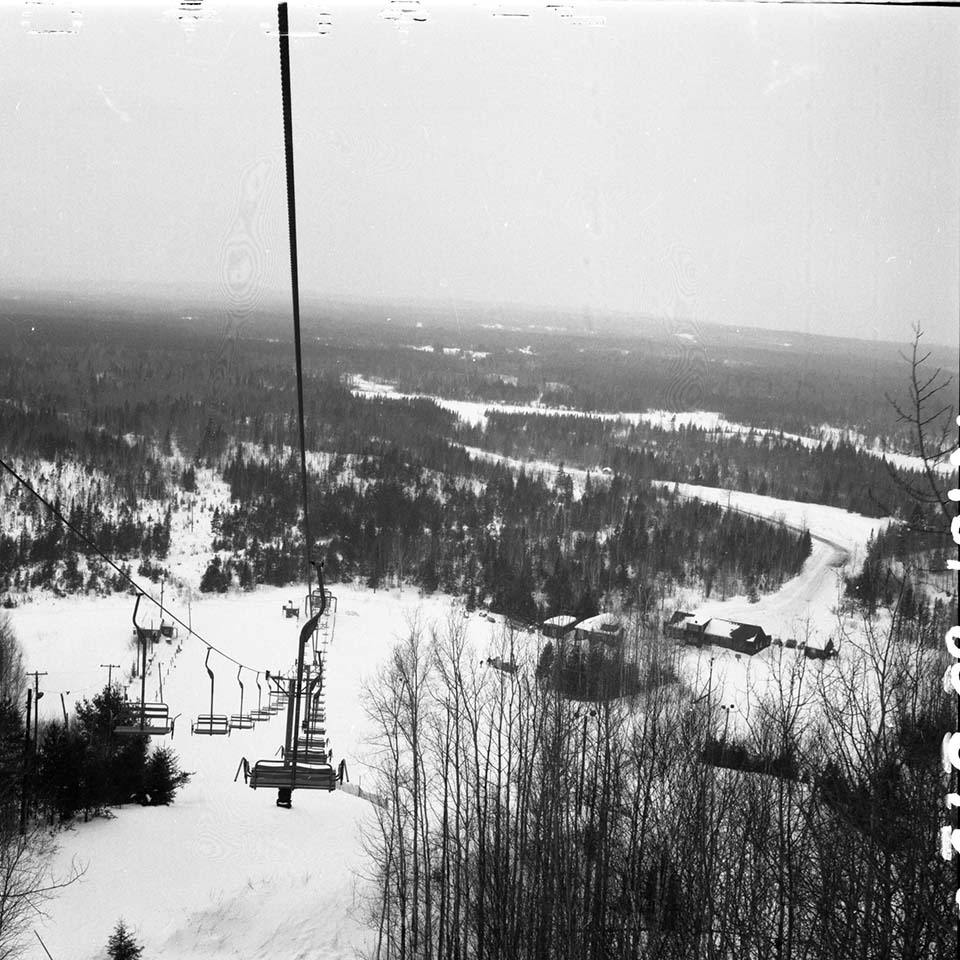
In April 1963 Tor and Knute put together a crew and started cutting trails on the north-east face of Mount McRae, about 13 kilometres from Fort William on the Scott Highway, past the Industrial Farm. The mountain sits a few kilometres west of today’s Fort William First Nation, on land covered by the Robinson-Superior Treaty, signed in 1850 by the Anishinaabe of Lake Superior.
They called it Little Norway. The papers reported a plan for a 90-metre jump built to international standards and a jumping school, to make the Lakehead “the jump capital of Canada” and to send more local jumpers to the Olympics; already by 1964 Fort William high school teacher Frank Gartrell (1941–2019) represented Canada at the Olympics.
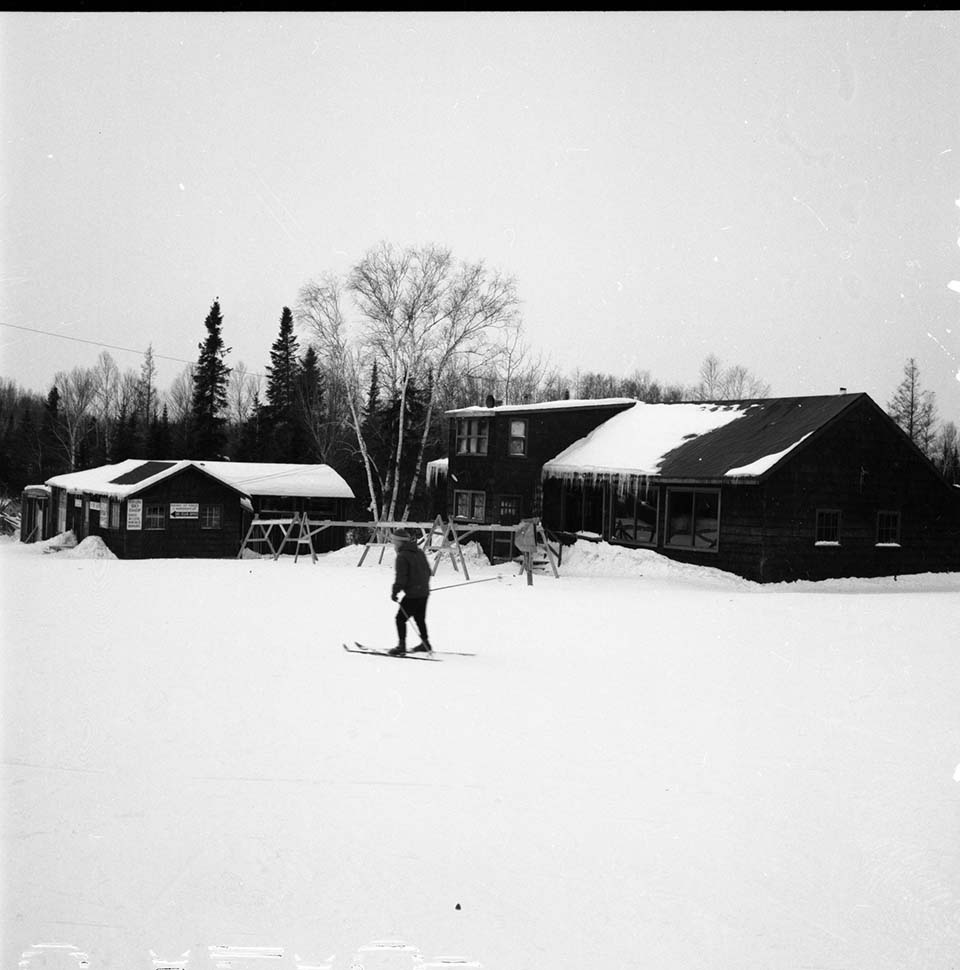
Tor once hauled a beam up a ladder by himself, one rung at a time. Another day he had to run from a runaway chainsaw. The first rope tow ran in February 1964. In March, the ski lodge still wasn’t finished, an ad that month admitted, adding, “we’re rough but ready,” and offered “good Norwegian coffee at 10 cents a cup.”
The hill was hard on its owners. In March 1966 Knute, then 50, hit a tree while checking the slopes and broke both legs. It was his first accident in 46 years on skis. Getting him down the mountain took two hours. In 1969, short of money, the brothers sold the hill.
World Cup
Eventually, the Provincial Government became involved in the hill, paying for the installation of two big jumps, 70 and 90 metres, which opened in 1975 as the Big Thunder National Ski Training Centre. The Government eventually purchased the site outright in 1985.
In January of 1980, Big Thunder held the first ski-jumping World Cup ever staged in Canada. The newspaper estimated 20,000 people on the final day: “the largest crowd ever for a Thunder Bay sports event.” Austria’s Armin Kogler won on both days. Steve Collins of Fort William First Nation and Thunder Bay’s Tauno Kayhko were named to the Olympic team for Lake Placid that winter.
The World Cup came back every season for more than a decade. Ottawa’s Horst Bulau went three years unbeaten on the 70-metre hill. Finland’s Matti Nykanen (1963–2019) won here four times.
The Worlds
When high winds battered the jumps at Calgary in 1988, there was talk of moving the Olympic jumping to Thunder Bay, making Thunder Bay co-host of the Olympics! Diane Imrie of the Northwestern Ontario Sports Hall of Fame remembers Rob McCormack, chief of competition for jumping at those Games, telling her it “was very, very close.”
In 1990, after two failed bids, Thunder Bay won the 1995 Nordic World Ski Championships, the first held in Canada. Organizers planned for about 2,500 volunteers; later accounts put the turnout at 1,500 to 2,000. For ten days in March 1995 close to 60,000 paid admissions went through the gates. More than 11,000 people watched the night team jump under a full moon. Steve Collins lit the flame at the opening ceremony, which included a First Nations pipe ceremony and hoop dance. Thunder Bay’s Ukrainian community gave money to Ukraine’s athletes, who were short of cash.
Tor Hansen, then 73, served as a local ambassador. More than sixty years after his family left Oslo, the publicity helped him find relatives in Norway he had never known about.
Big Thunder wasn’t only for jumpers. Freestyle had a home there too: ballet, moguls and aerials, and a water ramp for summer training. Local Olympian Amber Peterson, who grew up in Mariday Park and started her freestyle career at the hill, told Bayview Magazine that it was great because they had the facilities for all three disciplines. “I did my first jumps into water at the water ramp they had built,” she said. The water ramp and air site, she added, “definitely made it easier for me to get into with the access.” Later more sites were built, and she travelled to them.
The province ended its funding, and on June 30, 1996, fifteen months after the Worlds, the gates at Big Thunder were locked. “It was too bad it closed down,” Amber said, “however I am sure it was difficult to maintain all of the venues.” It was certainly missed; Daniel Kardas told CBC in 2018 that even at the 2002 Olympics, people from around the world kept asking, “What’s going on with Big Thunder?”
Epilogue: Recreational Skiing
Besides this serious venue, Thunder Bay has always been home to a passionate community of recreational alpine skiers.
In 2016 another set of brothers, Kristof, Daniel and Jason Kardas, sons of the ski-jumping coach Slavomir Kardas (1945–2021), bought Mount Baldy.
My Uncle Doug Currie skied Mount Baldy most weekends from about age ten in 1953 until he moved to Fort Frances in 1967.
In the winter of 1960 while at Port Arthur Collegiate, he recalls, “you have about a dozen grade 12ers on a Friday, skipping classes to go skiing. Who shows up at the ski hill? Ross Rogers, the Vice-Principal and he didn’t come out to ski!!! After-school detentions for everyone, including yours truly!! Worth every minute in detention!”